What is GDDAO?
GDDAO is an AI collaboration platform for teams and organizations, developed by Guppy Digital Technology. It connects teamwork, data collection and outcome preparation so internal teams, external partners and AI can work in a shared context.
Who it serves
- Teams and professional services that collect information and deliver reports or other outcomes.
- Enterprise ESG, sustainability and cross-organization project teams.
- NGOs, associations, foundations and grant-funded project teams.
A practical workflow
- Create a workspace and agree on membership and information access.
- Define a project, responsibilities, tasks and deliverables.
- Collect relevant conversations, activity records, questionnaire responses, recordings and documents.
- Select available sources and ask AI to help search, summarize, analyze or draft.
- Have people check the content, figures, sources and publication scope before delivery. Retain useful material for the next project.
This is a recommended working method, not a claim that every feature automatically feeds every report. Follow the relevant guide and available interface for each integration.
Data has sources. Outcomes can be verified. Knowledge can be reused.
People remain responsible
AI assists with information organization and drafts. People edit, confirm and decide how to use the result. An AI summary is not a verified fact, and a generated report is not independent assurance or certification. Complete claim, evidence-dependency and professional-review governance remains under development.
Start with common workflows or quickstart.
Start with one small complete cycle
You do not need to migrate all historical material first. Choose an upcoming deliverable such as meeting notes, an activity summary, or a partnership proposal. Prepare one original source and clear requirements. Have one person prepare it and another review it before expanding to more people.
| Starting point | Prepare | First deliverable |
|---|---|---|
| Meeting or interview | Audio, topic, and participant roles | Checked notes and next actions |
| Activity closeout | Activity details, attendance, and feedback | Summary with clear periods and counting rules |
| Cross-organization work | Scope, contacts, and existing material | Discussable proposal and missing-information list |
Check whether adoption helps
Perform a real handoff: ask another member to locate the sources, identify what remains unconfirmed, and continue the task. If only the author can explain it, improve names, locations, and requirements first. More documents are not the goal; continuity of work is.
Start with quickstart or mobile work.
Start from this screen
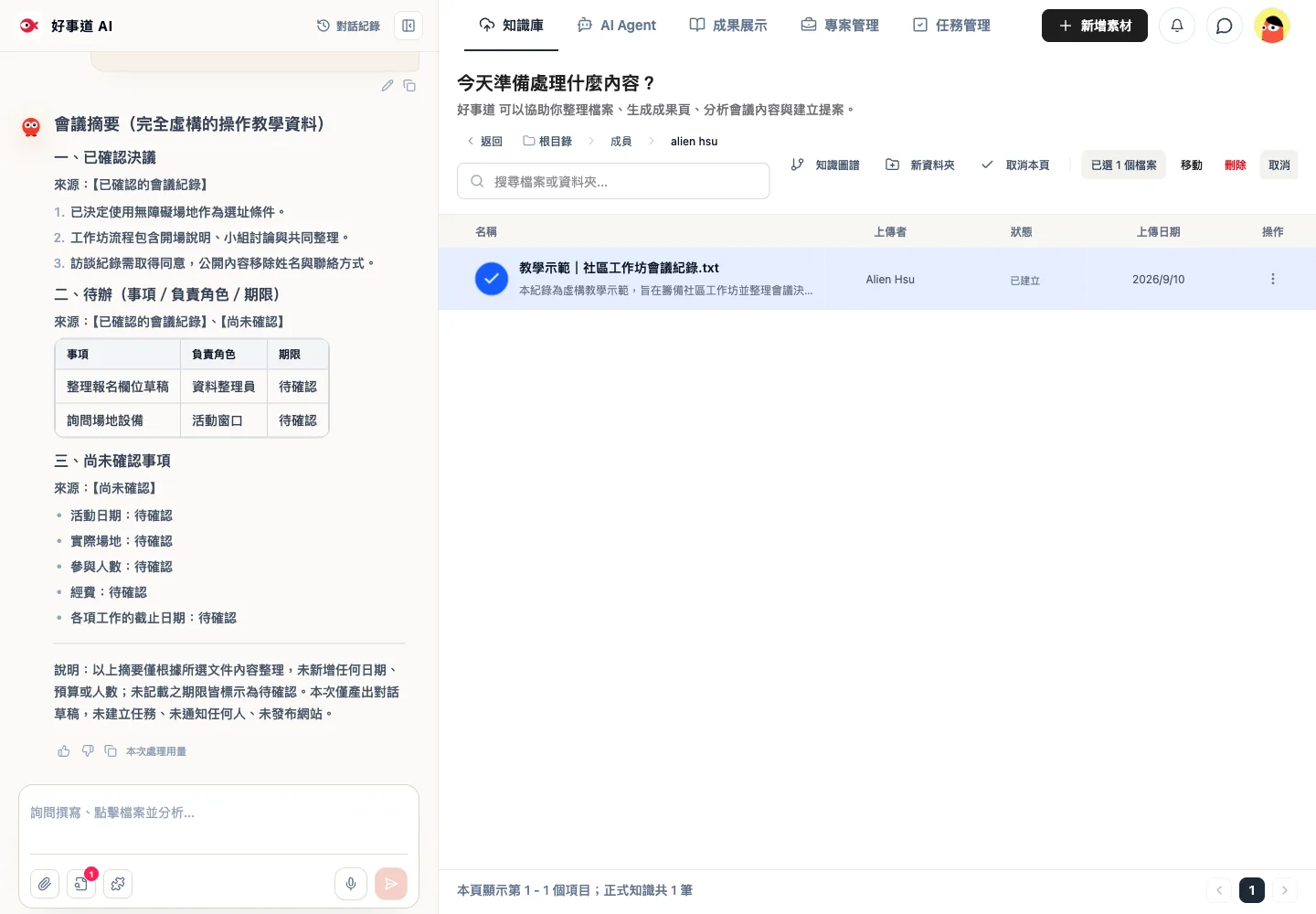
Understand GDDAO through one concrete problem
Imagine preparing a community workshop. Venue discussions live in chat, one colleague keeps the registration sheet, and field staff collect photos and audio. At handoff, the owner needs to establish what happened, what can be reused, and what is still missing.
Use projects to describe goals, tasks to assign delivery, activities and questionnaires to collect information, and knowledge with AI to organize it. Begin with the part that addresses your immediate need and connect more functions over time.
| Concept | Question it answers | Workshop example |
|---|---|---|
| Workspace | Which team am I working for? | The tutorial team's data scope |
| Project | Why are we doing this and when is delivery? | Workshop preparation and records |
| Task | Who delivers what? | Draft registration fields |
| Activity | How do people participate? | Registration and field participation |
| Knowledge | How can we find material again? | Venue notes and transcripts |
| AI draft | How can material become readable? | Decisions, actions, and open questions |
Prepare for the first day
Choose one usable source, a clear output, and a reviewer. For example, use meeting notes to produce a decisions-and-actions table, reviewed by the meeting owner. Finish that small cycle before importing a large archive.
Choose a reading route
For information work, read knowledge, AI collaboration, and reports. For field work, start with app recording, sharing, and task delivery. For team rollout, begin with account context and member administration.
Judge adoption by whether another person can find the source, understand the requirements, and continue the work. Successful sign-in and many new projects establish setup, not a complete handoff.