Sources, confirmation and reusable knowledge
GDDAO connects collaboration, data collection and outcome preparation. Trust grows from inspectable work and responsible decisions.
Keep sources with the work
Retain relevant documents, questionnaire exports, activity records and recording transcripts. Describe the period, scope and limitations of each source. A link alone does not prove a conclusion.
Review before use
Ask AI to distinguish source material, interpretation and missing information. A responsible person should check figures, quotation context, personal information and publication scope. Record outstanding questions as tasks and keep the agreed deliverable in the workspace.
Understand the limits
An organization claiming its public Agent page is not equivalent to independent verification of every statement. Public source material and confirmed facts are distinct. Formal claim/evidence governance and professional assurance must not be assumed to exist for every workflow.
See common workflows.
Practice reviewing an outcome statement
Suppose a draft says participants are more willing to join community action. Determine whether this comes from interview perceptions, survey self-reporting, or observed subsequent behavior. Each supports different conclusions; describe the period and limitations.
Group review comments into usable material, wording to revise, and missing information. Satisfaction responses without follow-up can describe the current experience, but should not be presented as evidence of lasting change.
Review before delivery
Check matching subjects and periods, distinguish inferences from observations, retain definitions and sources for figures, and have an owner confirm wording and publication scope.
This is a review practice a team can adopt, not a claim that every check has its own automated interface. Use the applicable professional process when formal assurance or certification is required.
Use task delivery as a review starting point
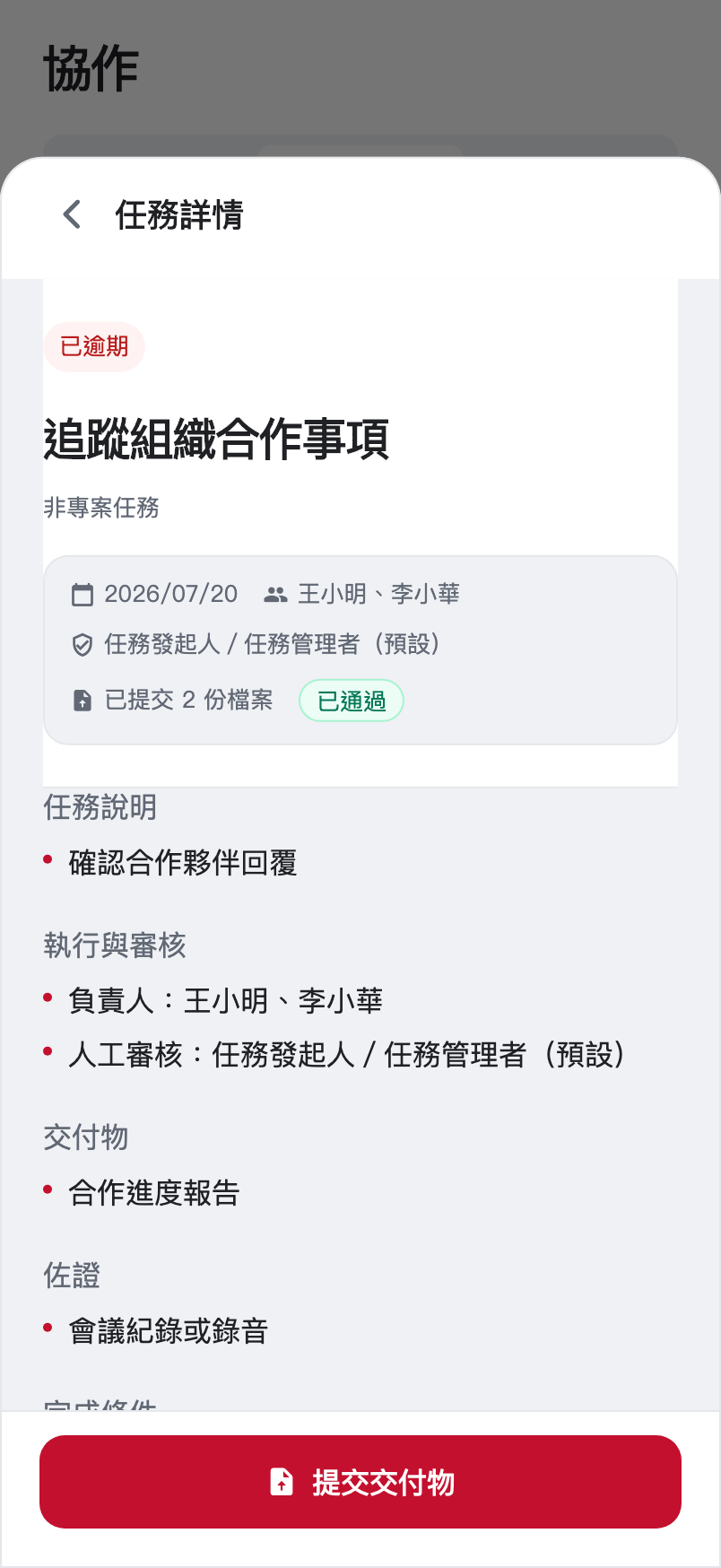
Organize a claim, its source, and its review
This is a human review method that can live in a document or spreadsheet, not a promise of a dedicated certification interface. Place the intended statement beside supporting material, the judgment, and open questions.
| Intended statement | Available material | Decision |
|---|---|---|
| Accessibility was selected as a venue criterion | A recorded meeting decision | Describe the planning decision |
| The venue meets accessibility needs | Criteria only, no venue check | Obtain verification before claiming completion |
| The workshop improved long-term participation | No follow-up evidence | Treat as an evaluation question |
Give confirmation a scope
One person may check dates and venue, another statistics. Record those scopes so “I reviewed the document” is not mistaken for approval of every claim. Recheck affected parts when important figures or conclusions change.
Prepare a public version
Identify personal information, partner details, and unresolved discussion before selecting public passages. Explain methods and limitations without publishing complete participant lists. Retain an internal source cross-reference for later maintenance.
Reuse requires renewed judgment
Recheck period, population, and purpose. Feedback from one activity cannot establish outcomes for another, and an old organization description may be outdated. Reuse provides a documented starting point; it does not remove the need to assess fitness.